Last week we talked about plasma and the currents that connect the Sun to Earth. This week, we’d like you to go see their effects for yourself.
As you read, keep this in mind: how you understand the universe has far more profound implications for everyday life than you might imagine. If that seems hard to grasp, stay with us and you’ll eventually see why.
Northern Lights
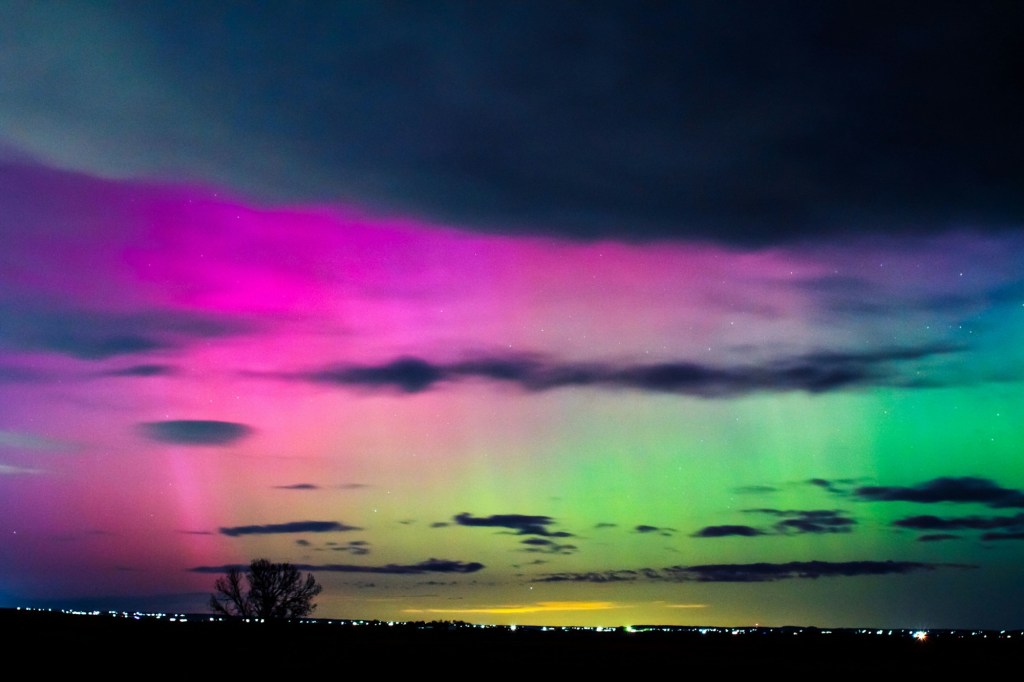
The aurora is one of the few places where you can watch space plasma at work with your own eyes. Those glowing curtains of green and violet light are charged particles from the Sun interacting with Earth’s upper atmosphere, guided along Earth’s magnetic field.
You don’t have to live near the Arctic to try. Strong solar activity can push the aurora much farther south than usual. The NOAA Space Weather Prediction Center publishes free aurora forecasts, and checking one takes about a minute.
Two Ways to Explain the Same Lights
What mainstream science says: Charged particles from the solar wind are funneled along Earth’s magnetic field toward the poles. Energy stored in the magnetic field is released in events called magnetic reconnection, accelerating electrons into the upper atmosphere. They collide with oxygen and nitrogen, which glow green, red, and violet. The Sun’s energy comes from nuclear fusion in its core.
What the Electric Universe says: The aurora is an electrical discharge, much like a giant neon sign. Birkeland currents form a circuit between the Sun and Earth, and the lights appear where that current meets the atmosphere. Proponents put electric fields and circuits at the center of the story, and many argue the Sun itself is powered by an external electrical source rather than fusion alone.
Where they agree: Charged particles, field-aligned currents, and atmospheric gases glowing on impact.
Where they differ: What drives the current (magnetic reconnection or an electric circuit) and, at larger scales, what powers the Sun.
Same lights, different explanations. We’re not asking you to pick one today. We’re asking you to notice that there are two.
Try it Yourself
- Check the aurora forecast before sunset.
- Find a dark spot away from city lights and give your eyes 20 minutes to adjust.
- Look north, and bring a camera. Phones often capture more color than your eyes do.
If you see something, ask yourself what you’re actually looking at, and why it moves the way it does. Questions like that are where good understanding starts.
Personal note: We’ve gone looking for the northern lights a few times ourselves, but so far we haven’t been in the right place at the right time. Still, seeing the northern lights in person is on our list.
Photo credit: Heyzeus Escribo on Unsplash
Blue Cube Rocket suspects the sky has been trying to tell us something all along. We’ve been listening.

Get our latest posts in your inbox.



Leave a Reply